
Select Sales Order
 Reference Contents > Sales Order > Select Sales Order
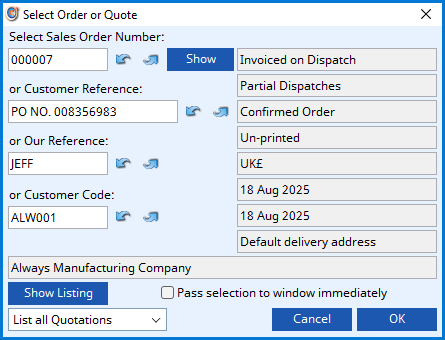
This window enables you to select an existing Sales Order or Quotation.
You can enter a SO number, Customer Reference, Our Reference or Customer Code to find the desired document. When passing out of each of the fields the system will find the closest matching SO record to the data entered. You can click on the Show Listing button to build a list of all SOs in the system controlled by the selection you make in the dropdown list below the button. You can also use the Show button to view the Sales Order or Quotation Details window.
|
Field |
Description |
|---|---|
|
Sales Order Number |
Sales Order Header. Sales order number (user’s not customer’s). {SOHFILE.SOHSONO char 6} |
|
Customer Reference |
Sales Order Header. Customer order reference. {SOHFILE.SOHCREF char 20} |
|
Additional Reference |
Sales Order Header. Additional user order entry reference. {SOHFILE.SOHAREF char 6} |
|
Customer Code |
Sales Order Header. Customer code. {SOHFILE.SOHCUSC char 6} |
|
Customer Name |
Customers. Customer company name. {CUSFILE.CUSCNAM char 40} |
|
Invoice on Dispatch |
Sales Order Header. No invoice on dispatch. {SOHFILE.SOHNINV boolean} |
|
Stop Status |
Indicates the status of any order stop conditions. |
|
Order or Quotation |
Sales Order Header. Order released flag. {SOHFILE.SOHRELF boolean} |
|
Printed Flag |
Sales Order Header. SO printed flag (YES = printed). {SOHFILE.SOHPRNT boolean}
|
|
Currency and Invoice Type |
Sales Order Header. Invoiced flag (Yes=Pro-Forma Invoice prepared). {SOHFILE.SOHINVF boolean} |
|
Quotation Date |
Sales Order Header. Date of quotation. {SOHFILE.SOHDAQO date date1980} |
|
Sales Order Date |
Sales Order Header. Date order entered into the system. {SOHFILE.SOHDATE date date1980} |
|
Delivery Address |
Indicates whether the order has an alternative delivery address. |
|
Pass selection to window immediately |
Check to cause the selection to be immediately reflected on the target window. |
|
Explode Kit Items |
Check to show kit items exploded in the document. |
 NOTE: If you have privileges to change a sales order, you can double-click on this field to change its status from printed to un-printed and visa-versa.
 TIP: Normally, when the same part is applied to consecutive line items any part extra texts (individual or standard) are suppressed so the first line only contains them. This is to reduce unnecessary duplication. However, this normal behaviour can be prevented with the user Option optSOPartTextDupl set to 1. Extra texts are then repetitively printed. If this option is set the effect will apply to all customer documents including Sales Orders, Jobs and Invoices.
|
Button |
Action |
|---|---|
|
Show |
Click to open the Sales Order or Quotation Details window. |
|
Show Listing |
Click to show a list of quotations and orders based on the selection below. |
|
List Contents Dropdown List |
Choose a selection for the listing. |
|
Cancel |
Aborts the process currently in session. The keyboard equivalent is the Esc key for Windows computers and Command-.(full stop or period) for the Mac. |
|
|
Will cause a report to be printed of the subject matter. Right-click to change the report destination. |
|
OK |
The OK button updates the data you have entered, or confirms the selection and/or processes the function you have called. |
Unlocking a locked order
If you select an order that another user currently has open, you are shown a message telling you the record is locked. Normally you can only wait for the other user to release it.
From v6.0008, nominated users are additionally offered an Unlock button on that message. Unlocking releases the record so it can be opened. The flow is three steps: you are told the record is locked and offered the Unlock button, you confirm that you want to unlock it, and the lock is then released so the order can be selected.
The button appears only for users listed in the relevant system option, as a comma-delimited list of User IDs. Use the option matching the document type: optSOUnlock for Sales Orders and Quotations.
 WARNING: Only unlock an order if you are certain it is not genuinely in use. Unlocking a record that another user is actively editing risks their work being lost or the two sets of changes conflicting. The intended use is recovering an order left locked after a crash or an unclean exit — it is a cleaner alternative to re-uniting missing relatives.
| See also: – |
Compiled in Program Version 5.10. Help data last modified 11 Nov 2012 04:02:00.00. Class wSalesOrderno last modified 17 Oct 2017 04:29:56.
Reference Contents > Sales Order > Select Sales Order